The Bernina Express, operated exclusively by the Rhaetian Railway (RhB), holds a distinct status in railway history. Inscribed alongside the Albula Line on the UNESCO World Heritage list in 2008, it is one of only three railway lines in the world with full UNESCO cultural designation. Unlike typical alpine ascents of its magnitude, the Bernina Line operates completely without a rack-and-pinion system, relying instead on pure wheel-on-rail adhesion across grades reaching 70 per mille (7%).
Overcoming Altitude via Pure Adhesion Engineering
Constructed between 1906 and 1910 under chief engineer Friedrich Hennings, the Bernina Line confronted a massive topographical obstacle: scaling the Bernina Pass without expensive tunnel drilling beneath the massif. Standard steel wheels on steel rails experience acute traction loss when steep slopes exceed 40 per mille in wet or frosty conditions.
The solution lay in meticulous track curvature, electronic wheel-slip management, and high-frequency sanders. On the northern approach from Pontresina through Morteratsch, the line sweeps along gentle curves beneath the Morteratsch Glacier before climbing past the twin lakes of Lej Nair and Lago Bianco. The track tops out at Ospizio Bernina station, 2,253 meters above sea level—the highest surface station on any adhesion railway in Europe.
The South-Side Drop and the Brusio Spiral
The south ramp from Ospizio Bernina down to the Italian frontier at Tirano represents one of the steepest continuous descents in world transit. Over a linear run of barely 38 kilometers, the railway descends 1,824 vertical meters, transitioning rapidly from permafrost and snowdrifts to chestnut orchards and palm trees.
At Alp Grüm (2,091 m), the line perches on a narrow shelf directly overlooking the Palü Glacier and the valley floor of Poschiavo 1,000 meters below. To dissipate elevation without plunging beyond the critical 70 per mille limit, engineers constructed horse-shoe curves and hairpin tunnels carved into the cliff faces at Cavaglia and Cadera.
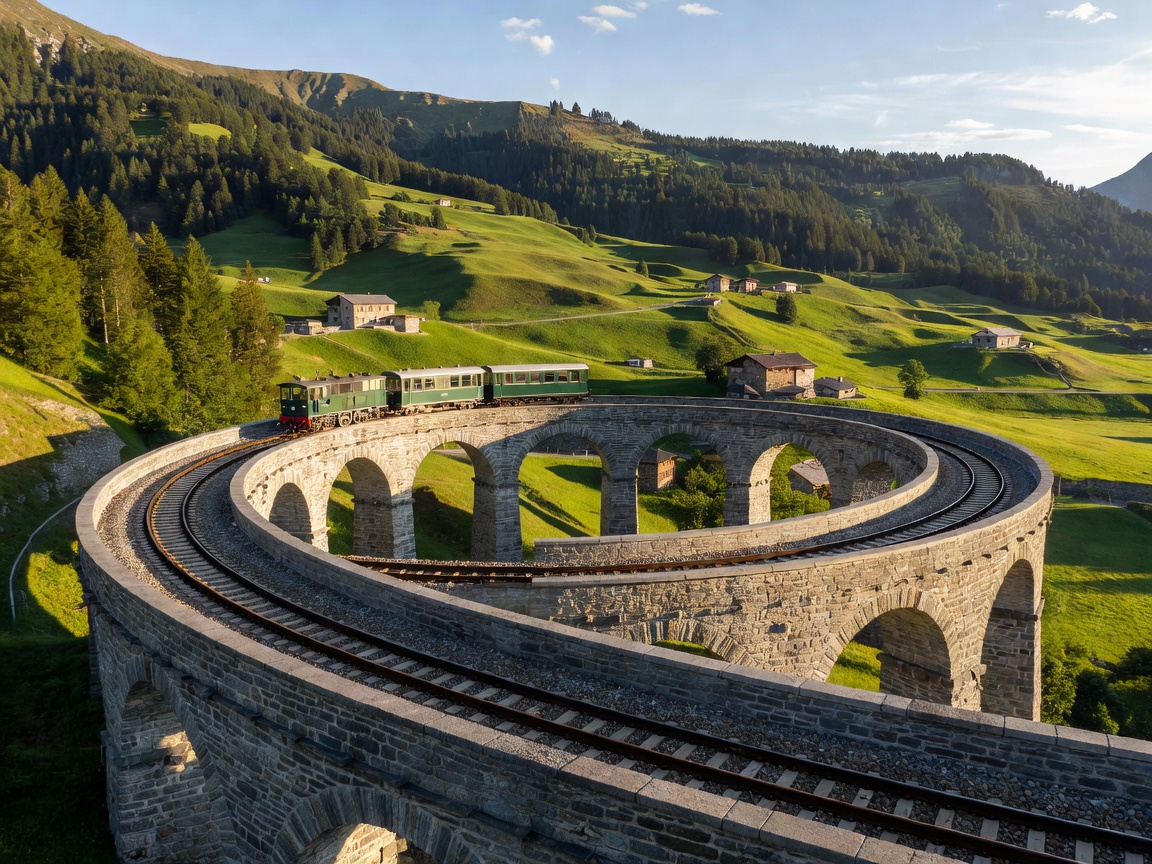
South of Poschiavo near the village of Brusio, topography presented a sheer bottleneck. To avoid an excessive slope in open terrain, engineers designed the Brusio Circular Viaduct. This stone masonry masterpiece loops through a complete 360-degree circle with an inner radius of 70 meters, gaining 10 meters of height while doubling back on its own alignment without requiring expensive switchbacks or cog infrastructure.
Dual-System Electric Traction
The Bernina Line originally utilized 1,000 V direct current (DC) overhead catenary, whereas the main Rhaetian Railway network north of St. Moritz and Pontresina utilized 11,000 V alternating current (AC) at 16.7 Hz. For decades, trains required locomotive changeovers or specialized shunting tractors at Pontresina.
In 2010, the RhB introduced the modern Stadler "Allegra" (ABe 8/12) dual-system multiple units. These three-car trainsets seamlessly swap catenary modes on the fly while running at track speed. Furthermore, they feature water-cooled IGBT traction converters and eight powered axles, providing high tractive effort on 70 per mille wet rails alongside regenerative electro-dynamic braking that pumps surplus descent power into the regional grid.
| Segment | Distance | Elevation Change | Max Gradient | Key Engineering Feat |
|---|---|---|---|---|
| Chur to Samedan (Albula) | 67.7 km | +1,120 m | 35 ‰ | Solio & Landwasser Viaducts, Albula Tunnel |
| Pontresina to Ospizio Bernina | 17.9 km | +476 m | 57 ‰ | Montebello Curve & Morteratsch views |
| Ospizio Bernina to Poschiavo | 18.8 km | -1,239 m | 70 ‰ | Alp Grüm shelf & Palü zigzag tunnels |
| Poschiavo to Tirano (Italy) | 19.6 km | -585 m | 70 ‰ | Brusio Circular Spiral Viaduct |
Practical Information for Railway Travelers
Unlike the Glacier Express, standard regional trains run every single hour along the identical tracks as the official panoramic Bernina Express. Regional train cars feature openable windows, facilitating glare-free alpine photography, and do not require reservations or additional surcharges. The official Bernina Express panoramic cars require advance seat reservations with varying supplemental pricing depending on winter or summer operating timetables.