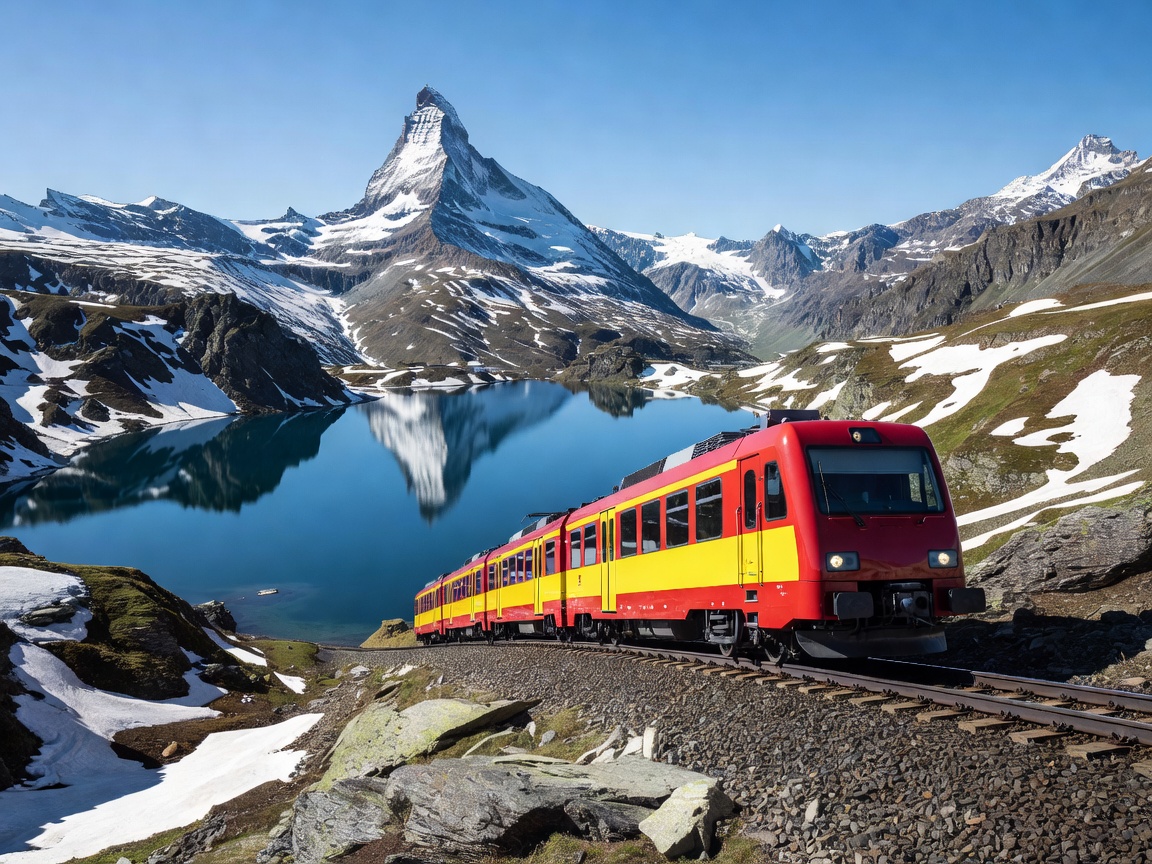
Inaugurated on August 20, 1898, the Gornergrat Railway (Gornergrat Bahn, GGB) in the canton of Valais holds the historic honor of being Switzerland's first fully electrified rack railway. Originating opposite the federal station in car-free Zermatt (1,620 m) and terminating on the Gornergrat summit ridge (3,089 m), the line operates in direct visual alignment with the Matterhorn (4,478 m), Monte Rosa (4,634 m), and the vast Gorner Glacier.
Three-Phase Electrification Innovation
At its construction in the late 19th century, standard mountain trains utilized steam traction, which suffered severe power drops at high altitudes due to low atmospheric pressure and required enormous coal haulage up mountainsides. Engineers Haag and Busch elected to build a dedicated hydroelectric plant on the Findelenbach river to power the line with three-phase alternating current at 750 V and 40 Hz.
Three-phase current required two separate overhead catenary wires side by side, with the running rails providing the third phase. This system presented remarkable operational advantages: simple induction motors operated at constant speed uphill, and when descending, they inherently functioned as asynchronous generators without complex control circuits, feeding electricity back into the grid while automatically holding the train at a safe descent speed. Today, the catenary runs modern 3-phase 725 V at 50 Hz.
The Abt Double-Rack Mechanism
The entire 9.34-kilometer alignment is fitted with the Abt rack system. Designed by Swiss engineer Carl Roman Abt, the system consists of two parallel vertical steel toothed racks offset by half a tooth pitch. The locomotive or railcar features twin driving cogwheels meshing simultaneously with both rack bars.
This staggered twin-tooth profile ensures that at any fraction of a second, at least two gear teeth are deeply engaged in the rack slots. This completely eliminates shock loads, prevents tooth slipping during sudden grade transitions, and guarantees full redundant braking capacity even under severe ice encrustation. With a maximum continuous incline of 200 per mille (20%), the train surmounts steep rock slopes without relying on adhesive wheel friction.
Intermediate Stations and Alpinist Utility
The Gornergrat Bahn operates 365 days a year, functioning not only as an excursion platform but as a critical transport feeder for high-alpine sports:
- Findelbach (1,770 m): Crossing the 93-meter-long Findelenbach Viaduct above a steep river gorge.
- Riffelalp (2,211 m): Gateway to Europe's highest resort hotel, serviced during summer by the 675-meter-long Riffelalp Tramway.
- Riffelberg (2,582 m): A key interchange hub for ski networks and base station for hiking routes toward the Matterhorn Glacier Paradise.
- Rotenboden (2,815 m): The access trailhead for the famed reflection of the Matterhorn in Lake Riffelsee and summer climbing routes onto the Monte Rosa hut.
- Gornergrat Terminus (3,089 m): Home to the 3100 Kulmhotel Gornergrat, astronomical observatories, and an expansive panoramic terrace.
| Parameter | Gornergrat Bahn (GGB) | Pilatus Bahn (PB) | Jungfraubahn (JB) |
|---|---|---|---|
| Rack Type | Abt Double-Rack | Locher Horizontal Twin | Strub Single Rack |
| Max Gradient | 200 ‰ (20%) | 480 ‰ (48%) | 250 ‰ (25%) |
| Summit Altitude | 3,089 m | 2,073 m | 3,454 m |
| Track Nature | 100% Surface Ridge Track | 100% Surface Rock Wall | 80% Deep Mountain Tunnel |
Environmental and Winter Engineering
Because the alignment traverses an open ridge exposed to high-alpine winds and severe snowdrifts, over 3.7 kilometers of the 9.34-kilometer route are protected by snow sheds and stone galleries. The current rolling stock consists of double-car Stadler railcars equipped with regenerative braking units that return approximately 30 percent of the energy expended during ascent back to the local Zermatt electricity grid.