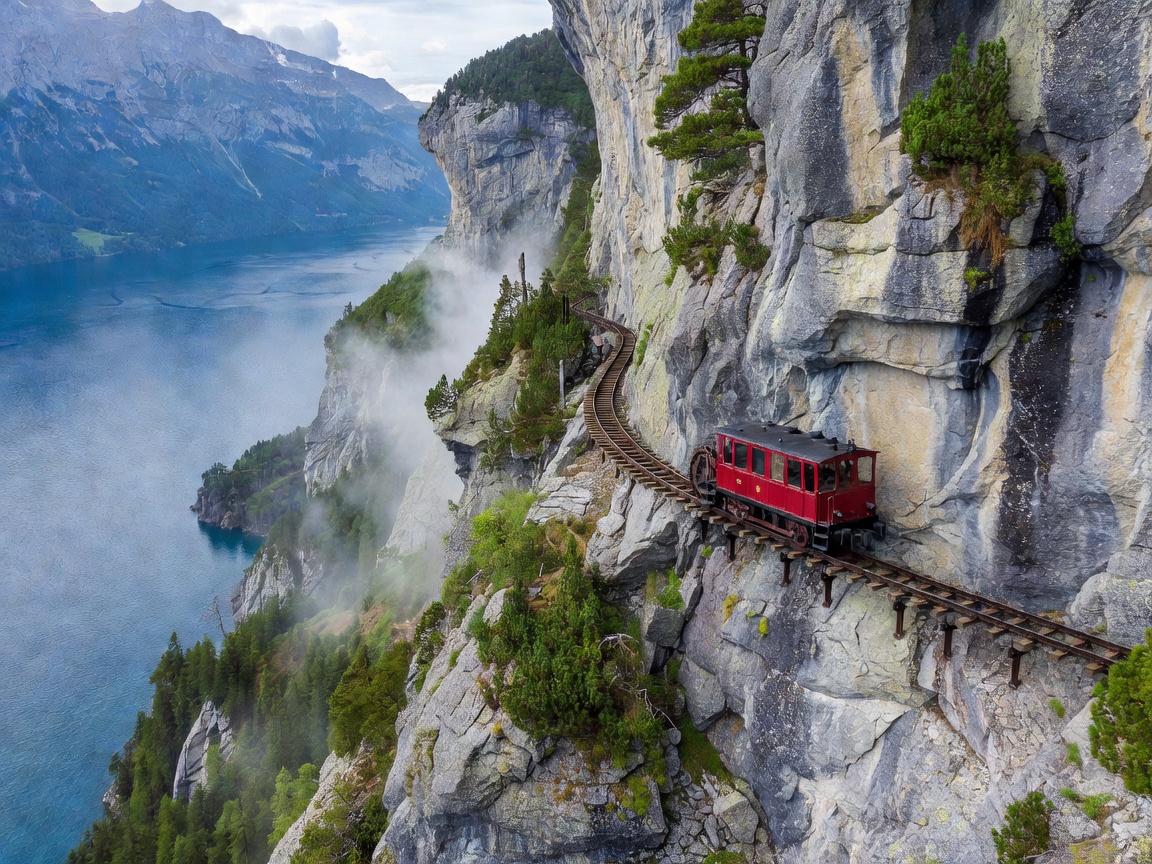
Rising from the shores of Lake Lucerne at Alpnachstad (440 m) to the precipitous summit ridge of Pilatus Kulm (2,073 m), the Pilatus Railway (Pilatusbahn, PB) is the steepest rack railway in the world. Engineered by Eduard Locher and opened in June 1889, the line conquers an elevation gain of 1,629 meters over a running distance of just 4.61 kilometers, reaching an extreme maximum gradient of 480 per mille (48 percent) and an average incline of over 38 percent.
Why Standard Cogwheels Failed: The Locher System
Prior to the construction of the Pilatus line, mountain rack systems (such as Marsh, Riggenbach, and Abt) relied on vertical gearwheels engaging downward into horizontal tooth bars. On slopes approaching 50 percent, mathematical analysis revealed a catastrophic vulnerability: the upward thrust generated by the gear engagement, combined with violent mountain gusts, would physically lift the drive pinion out of the rack bar, causing immediate runaway derailment down the mountainside.
To eliminate this physical limitation, Eduard Locher devised an entirely unique design: the Locher Rack System. Instead of a vertical cogwheel, the Locher system places a central rail with teeth cut horizontally into both sides. The locomotive is fitted with two opposed horizontal gearwheels that clamp the central rail from both flanks simultaneously.
Because the teeth engage horizontally from opposite sides, upward mechanical lift is geometrically impossible. Furthermore, deep safety guide disks sit directly below the gear teeth, physically clasping the underside of the rail head. The train is structurally clamped to the track bed, making mechanical derailment impossible even on near-vertical cliff faces.
Unique Trackwork: Turnouts and Rotary Transfer Tables
Because the Locher central rack rail features gear teeth on both exterior faces, standard railway points (switches) cannot function without severing the continuous rack bars. Locher solved this through custom mechanical track changers:
- Rotary Swiveling Tables: At terminals, cars are transferred between running tracks using track decks that rotate around a central longitudinal or vertical axis.
- Translating Turnouts: Flexible, articulated track sections that slide laterally across granite slabs on hydraulic rams to redirect rolling stock between passing tracks.
2023 Modernization and Fleet Replacement
For over 80 years, the line relied on historic electric railcars constructed in 1937. Between 2021 and 2023, Pilatus-Bahnen AG executed a comprehensive 35-million-Swiss-franc modernization program. Working in collaboration with Stadler Rail, eight custom-engineered railcars were introduced into scheduled service.
The new railcars feature wrap-around low-profile panoramic glazing, regenerative dynamic braking that returns electrical energy to the 1,500 V DC catenary during descent, and modern electronic collision avoidance sensors. The cars maintain an ascent speed of 15 km/h and a safe descent limit of 9 to 12 km/h across the steepest rock segments of the Mattalp and Eselswand.
| Segment / Station | Distance | Altitude | Gradient | Terrain Characteristics |
|---|---|---|---|---|
| Alpnachstad (Valley) | 0.0 km | 440 m | Flat / depot | Interchange with SBB trains & Lake Lucerne steamers |
| Wolfort Gorge | 1.3 km | 890 m | 32% | Masonry bridge across sheer limestone chasm |
| Ämsigen (Crossing Loop) | 2.4 km | 1,355 m | 39% | Midway passing loop with translating track changers |
| Eselswand (The Donkey Wall) | 4.2 km | 1,910 m | 48% (Maximum) | Sheer exposed cliff ledge with four blasted tunnels |
| Pilatus Kulm (Terminus) | 4.6 km | 2,073 m | Terminal grade | Summit hotels, cliff trail galleries & cableway link |
Operational Seasons: The Golden Round Trip
Because the Pilatus Railway climbs exposed north-facing cliffs with sheer drops prone to severe winter avalanches, the rack line operates strictly during the snow-free season from mid-May through mid-November. During the winter months, high-altitude access to Pilatus Kulm is maintained from the northern flank via the Kriens aerial panorama gondolas and the "Dragon Ride" cableway. This configuration enables the popular "Golden Round Trip": taking a steamer boat from Lucerne across the lake to Alpnachstad, ascending on the 48% cogwheel to Pilatus Kulm, descending by cable car to Kriens, and returning to Lucerne by electric trolleybus.