The Glacier Express is an iconic narrow-gauge service operating jointly across the infrastructures of the Matterhorn Gotthard Bahn (MGB) and the Rhaetian Railway (RhB). Traversing three Swiss cantons—Valais, Uri, and Graubünden—the journey requires approximately eight hours of running time. Rather than competing with high-speed lowlands corridors, the line serves as a continuous, high-altitude alpine transit artery utilizing metric gauge track (1,000 mm) and selective Abt rack sections to negotiate extreme elevation differentials.
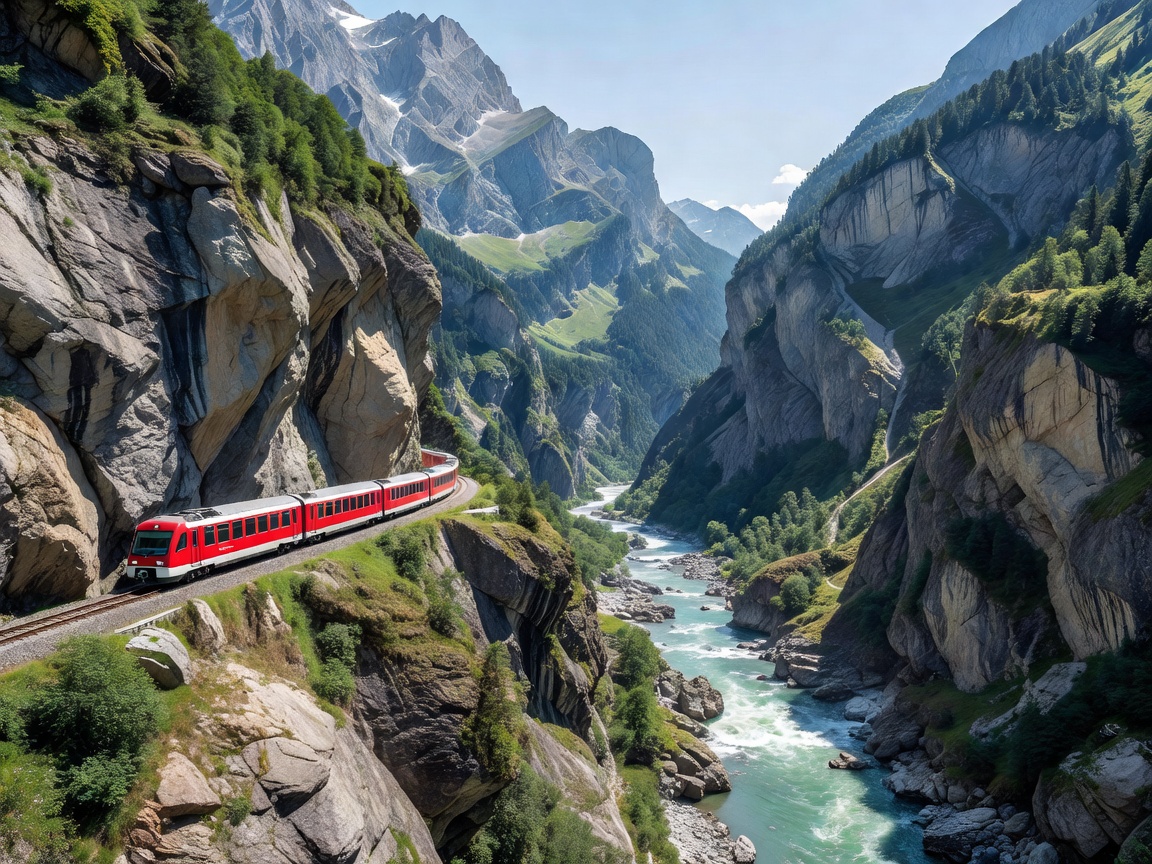
Track Profile and Geological Passages
Departing Zermatt at an altitude of 1,604 meters in the shadow of the Matterhorn, the train follows the Mattervispa river canyon downward through St. Niklaus to Stalden-Saas, utilizing cogwheel descent segments with gradients up to 125 per mille. At Brig (670 m), the line enters the broad Rhône Valley before ascending through the Goms region to Oberwald.
Historically, the Glacier Express scaled the exposed Furka Pass summit track, which crossed directly past the Rhône Glacier. Due to extreme avalanche risks and winter closures exceeding seven months each year, the Furka Base Tunnel was opened in 1982. This 15.4-kilometer tunnel bypasses the surface pass between Oberwald and Realp, enabling uninterrupted year-round scheduled operations while the historic high-pass line was preserved as a heritage steam railway.
From Realp, the train arrives at the junction town of Andermatt in the Urseren Valley before undertaking its steepest sustained climb: the western ramp of the Oberalp Pass. Here, Abt-system dual toothed racks engage the locomotives, driving the consist to its geographical apex at 2,033 meters above sea level. Beside Lake Oberalp, the train crosses the watershed dividing the Rhône basin (flowing to the Mediterranean) from the Rhine basin (flowing to the North Sea).
The Ruinaulta and the Landwasser Viaduct
The descent from the Oberalp Pass winds down through Disentis/Mustér, where operational control transitions from the Matterhorn Gotthard Bahn to the Rhaetian Railway. East of Ilanz, the train navigates the Ruinaulta (the Rhine Gorge, often nicknamed the "Swiss Grand Canyon"), a deep limestone canyon created 10,000 years ago by the Flims Rockslide. Because no roads penetrate this sheer rock canyon, rail represents the sole terrestrial transport access through the gorge floor.
Reaching the canton capital of Chur (585 m), the train reverses direction to enter the UNESCO World Heritage Albula line. The structural zenith of this segment is the Landwasser Viaduct near Filisur. Erected between 1901 and 1902 without scaffolding towers, the 142-meter-long limestone viaduct features five curved arches rising 65 meters above the valley floor, terminating directly into the rock face of the Landwasser Tunnel.
Comparative Analysis: Direct Transit vs. Scenic Alpine Express
| Factor | Glacier Express Panorama | Standard Regional SBB/RhB Combination |
|---|---|---|
| Transit Duration | 8 hours 03 minutes (single seat) | Approx. 7 hours 45 mins (3 to 4 transfers) |
| Rolling Stock | Air-conditioned panoramic glass cars | Standard regional passenger coaches |
| Reservation Mandate | Compulsory supplement seat reservation | No seat reservation required |
| Dining Service | At-seat hot meal catering service | Vending or self-provided food |
| Window Accessibility | Fixed sealed glass (anti-reflective tint) | Drop-down hopper windows for clear photos |
Operational Strengths
- Direct, uninterrupted connection linking Valais and Engadin without luggage transfers.
- Engineered panoramic coaches offer 180-degree ceiling sightlines of cliff walls.
- Multilingual audio commentary tied to onboard GPS coordinate triggers.
Operational Limitations
- Compulsory seasonal reservation fees add to Swiss Travel Pass fares.
- Non-opening panoramic windows create glare on optical photography gear.
- Full eight-hour running duration may prove fatiguing without intermediate layovers.
Planning and Seasonal Considerations
The Glacier Express operates through two primary seasons: the Winter timetable (mid-December through April), characterized by heavy snow corridors over the Oberalp, and the Summer timetable (May through October), featuring full service frequencies with multiple daily departures in both directions. The service undergoes a mandatory six-week maintenance overhaul each autumn (typically late October through early December), during which no express trains run and regional stopping trains maintain transit along the tracks.