The Jungfrau Railway (Jungfraubahn, JB) represents the supreme climax of 19th-century mountain railway ambition. Conceived by industrialist Adolf Guyer-Zeller during an alpine walking tour in August 1893, the line was engineered to scale the Jungfrau massif directly from the mountain pass at Kleine Scheidegg (2,061 m) to the underground cavern of Jungfraujoch (3,454 m). Opened on Swiss National Day, August 1, 1912, it remains Europe’s highest railway station.
Sixteen Years of Tunnel Excavation
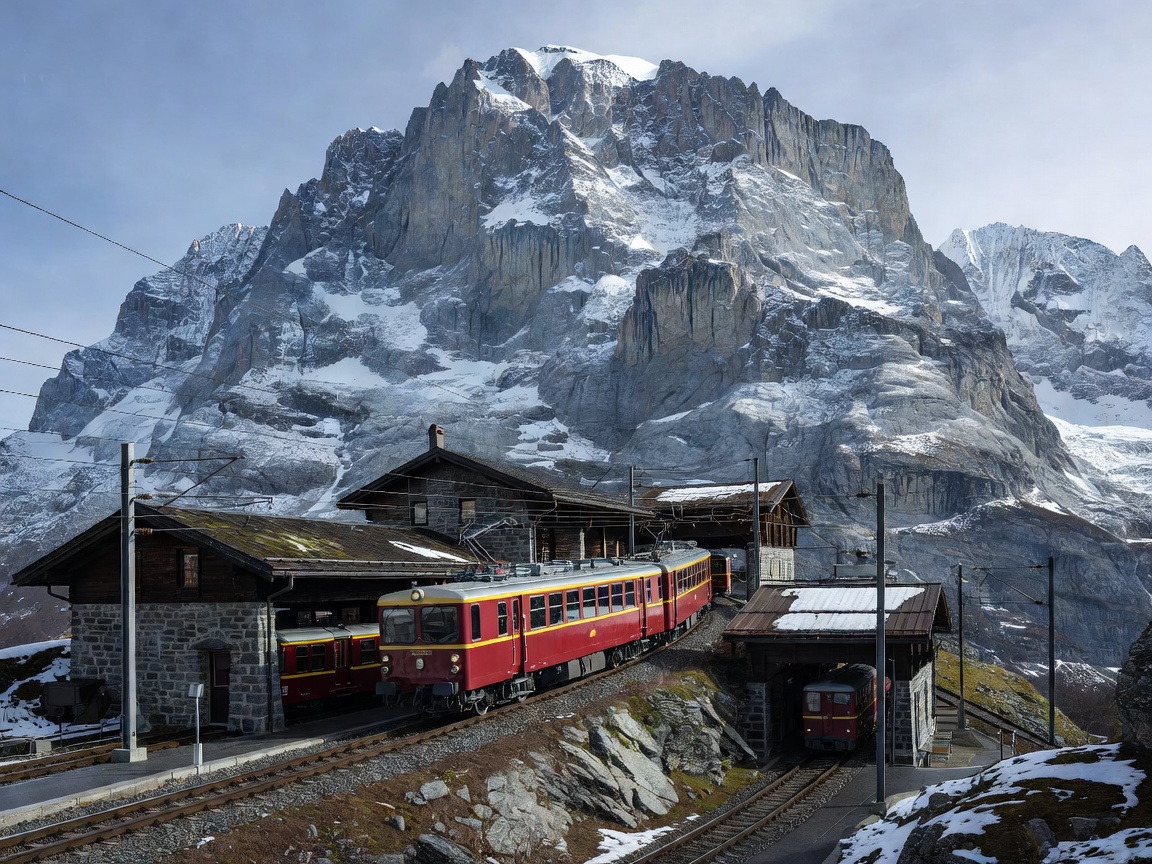
Construction began in 1896. While the initial two kilometers ran along open mountain meadows to Eigergletscher station (2,320 m), the remainder of the alignment had to penetrate the sheer rock massifs of the Eiger and Mönch to protect trains from catastrophic avalanches and winter storms.
Drilling a 7.3-kilometer curving tunnel through solid rock required sixteen years of arduous manual labor. Miners worked inside freezing, oxygen-thin tunnels using electric rock drills powered by hydroelectric plants built specifically for the project at Lauterbrunnen and Burglauenen. During excavation, transverse side galleries were blasted open to the cliff faces to vent dynamite smoke and dump blast rubble directly down the vertical north wall of the Eiger. These lateral openings later became the famous intermediate viewing stations of Eigerwand and Eismeer.
The Strub Rack Standard
To maintain absolute traction on grades up to 250 per mille (25%), the Jungfraubahn adopted the Strub rack system, invented by Swiss engineer Emil Strub. Unlike the twin-bar Abt system, the Strub system uses a single solid steel rail machined with broad involute gear teeth.
Crucially, the head of the Strub rail is shaped like a standard rail head with an overhanging lip. The locomotive and coach chassis are fitted with heavy safety claw jaws that curl beneath this overhanging lip without touching it during normal running. If severe track lift forces or unexpected aerodynamic wind gusts strike the trainset, these safety claws physically hook onto the rack bar head, mechanically locking the railcars to the roadbed and preventing derailment.
The Modern Eiger Express Integration
For over a century, reaching Jungfraujoch required taking the Wengernalp rack railway from Lauterbrunnen or Grindelwald up to Kleine Scheidegg—a scenic but slow trip requiring 45 minutes of ascent before even boarding the Jungfraubahn. In December 2020, the Jungfrau Railway Group inaugurated the "V-Cableway" project, centered on the tri-cable Eiger Express gondola.
Connecting Grindelwald Terminal directly to Eigergletscher station in just 15 minutes, the heavy-lift 3S gondola cuts the total travel time from Interlaken to Jungfraujoch by 47 minutes. Passengers step out of the cable car at Eigergletscher and immediately cross a sheltered indoor concourse to board the final rack train into the high-altitude tunnel.
| Station | Altitude | Distance | Operating Feature |
|---|---|---|---|
| Kleine Scheidegg | 2,061 m | 0.0 km | Wengernalpbahn interchange & depot workshops |
| Eigergletscher | 2,320 m | 2.0 km | Eiger Express 3S interchange & tunnel portal |
| Eismeer (Sea of Ice) | 3,158 m | 5.7 km | 5-minute panorama halt overlooking Ischmeer glacier |
| Jungfraujoch | 3,454 m | 9.3 km | Underground terminal, Ice Palace, Sphinx Observatory |
High-Altitude Science and Passenger Comfort
Beyond tourism, the Jungfraujoch terminal supports the High Altitude Research Station Jungfraujoch and the Sphinx Observatory (3,571 m). Because of the abrupt transition from low valley pressure (Interlaken at 567 m) to high altitude (3,454 m) in under 90 minutes via the modern routing, travelers are advised to move at a measured pace. The facility includes oxygen monitoring stations, medical first-responder rooms, and sheltered galleries linking directly to the Ice Palace excavated inside the glacier firn.